If you were lucky enough to get planting rain, let's not dampen the mood by touching up the neighbours' crops...
As we race to finish off winter planting and are trying to get pre-plant sprays done (most with Glyphosate as an inclusion), it is worth taking a breath to consider the risk of spray drift; there is still plenty of time to get our crops planted!
It is imperative to keep in mind that current conditions are creating a perfect storm for spray drift - specifically through temperature inversions. When spraying near sensitive crops, understanding the "invisible" physics of the air is the difference between a clean field and a major liability.
What is a Surface Inversion?
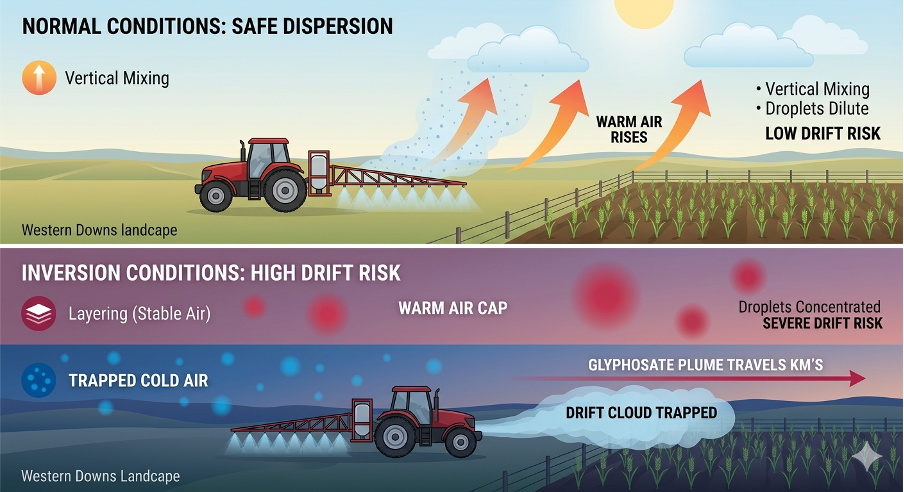
Under normal daytime conditions, air near the ground is warmer and rises, dispersing spray droplets upwards where they dilute. During an inversion, this process flips:
- The Setup: On clear, calm nights, the ground loses heat rapidly.
- The Trap: A layer of cool, dense air becomes trapped under a layer of warmer air.
- The Risk: Instead of dispersing, fine spray droplets stay concentrated in a dense "cloud" near the ground. This cloud can slide sideways across the landscape for kilometres, landing on non-target cereal crops with devastating precision.
Why are we at Higher Risk Now?
May and June are particularly hazardous in our region due to several local factors:
- Clear Skies & Low Wind: Our classic crisp winter nights and still mornings are the primary triggers for inversion layers.
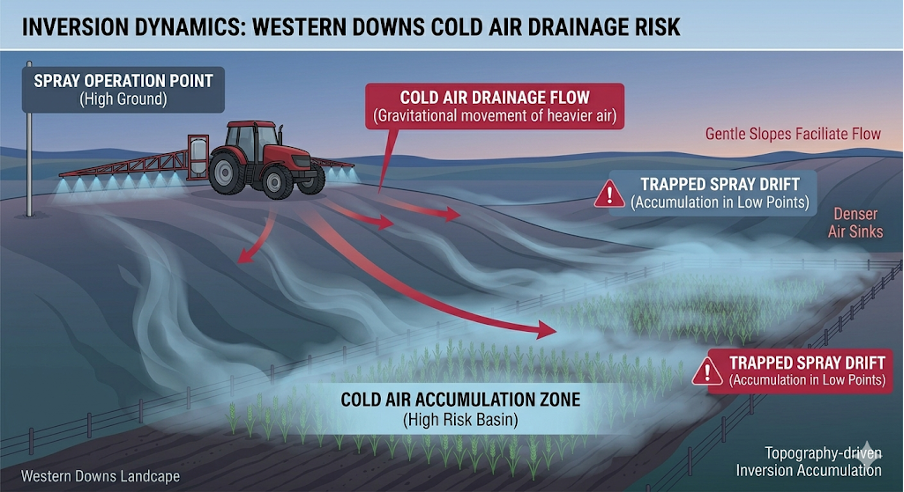
- The "Valley Effect": Many parts of the Downs and surrounding districts have subtle undulating topography. Cold air is heavier than warm air; it will literally "drain" like water into lower-lying areas, carrying glyphosate plumes directly into creek flats or sheltered paddocks where cereals are emerging.
- Dry Air Persistence: Inversions here often form before sunset and can persist well into mid-morning, long after the sun has come up.
- Cumulative Effect: With so much fallow spraying occurring at the same time, the amount of aerosolised herbicide adds up to create a much more risky situation. Don’t think your nozzle selection alone will keep you safe. Even if using a TTI nozzle, there is a % of driftable fines that may move off target, especially in an inversion scenario.
Glyphosate + Cereals = A Costly Mistake
While glyphosate is our go-to tool, it is non-selective. Even a low-dose drift event during the early growth stages of cereals can lead to:
- Stunted root development.
- Chlorosis (yellowing) of new growth.
- Significant yield loss, or
- Total crop failure in the affected drift zone.
Safe Spraying Checklist
To protect your and your neighbours’ crops, follow these golden rules:
- Check the "Delta T": Aim for a Delta T between 2 and 8. Avoid spraying when the air is too still.
- Watch the Smoke: If you see smoke/fog or dust hanging horizontally in the air rather than rising, stop immediately. This is a visual confirmation of an inversion.
- Nocturnal Caution: Avoid spraying from sunset until at least one or two hours after sunrise, when the ground has had a chance to warm up and break the inversion layer.
- Check your WAND Network: Before going spraying, be sure to check in with your local WAND Tower.
- The WAND is a real-time hazardous weather warning system developed in Australia
- It utilises a network of over 100 profiling inversion towers. These towers use remote sensing to detect hazardous temperature inversions
- It updates every 10 minutes and offers a 24-hour forecast, allowing you to look 2 hours forward and 2 days back, without a subscription
The Bottom Line...
If the air is dead, keep the rig in the shed!
It's not worth the risk.